Greenbar is managed EDI for small suppliers. Your retailer sends
whatever format they use; you get a readable order and answer it by confirming what
actually shipped. No EDI software, no developer.
$79 a month, or $69 for the first ten customers. Published on this
page, not quoted on a call.
A retailer sent you an EDI deadline.
You forward it to us, we connect to them, and you read orders like email and confirm
what shipped.
That is the whole job. Everything below is for whoever checks the details.
850 Purchase OrderPO-88412 · 004010 · 3 line items
What your partner sends
ISA*00**ZZ*NORTHRIDGEDIST*…
GS*PO*NORTHRIDGEDIST*CASCADEMFG*…
ST*850*0001
BEG*00*SA*PO-88412**20260929
DTM*002*20261012
N1*ST*Northridge DC East*92*NRD-DC2
N3*1200
Logistics Way*Dock 14
PO1*1*240*EA*4.85**BP*NR-HB-0375
PID*F****Hex bolt, 3/8-16 x 1.5in
CTT*3
SE*19*0001
What lands on your webhook
{
"type":
"purchase_order",
"po_number": "PO-88412",
"order_date":
"2026-09-29",
"dates": {
"delivery_requested":
"2026-10-12" },
"parties": { "ship_to":
{ "name": "Northridge DC East" } },
Your retailer’s documents arrive in a form you can read, and your answers go back
in the form they demand. The two cells below are the ones that save you money: the
commonest deductions a small supplier gets are impossible here by the way the thing is
built.
Chargebacks
Your ship notice is their order, confirmed
The commonest deduction a small supplier gets is a ship notice that does not match
the purchase order. Here you do not describe a shipment; you confirm an order we are
already holding, so the part numbers, prices and ship-to come straight off their own
document. You fill in what shipped and in how many cartons. There is nothing to
retype, so there is nothing to mistype.
Chargebacks
The carton label and the notice cannot disagree
A pallet number on the label that differs from the one in the ship notice is the
single most common compliance failure in the trade. When you answer an order here,
both come out of the same allocation at the same moment, not two systems asked to
agree, one number used twice. We keep the counter, so a number is never reissued
either.
Translation
X12, both ways
Purchase orders in, acknowledgments, ship notices and invoices out. Valid on the
first try, because every document we generate is read back and checked again before
it leaves.
Acknowledgments
997s, automatically
Most retailers treat a missing functional acknowledgment as a failed transmission
and escalate. We send them, and we read theirs, so a rejection gets to you while
there is still time to fix it.
Connectivity
One address, allowlisted once
Your retailer connects to sftp.palletlabs.org on port 22 — one
hostname, two fixed IP addresses for their firewall, and an SSH key that never
changes. They add it once. AS2 is set up but not yet proven: the server is live at
as2.palletlabs.org with our certificate issued, and it has not yet exchanged
a message with a real retailer. If yours needs AS2, tell us before you commit.
Formats
You never have to see X12
Orders reach you as CSV, JSON or XML in your own column names, and you can send us
the same back. If you would rather work in the raw EDI, it is all there. Plenty of
people want one and not the other, so neither is the only way.
Your records
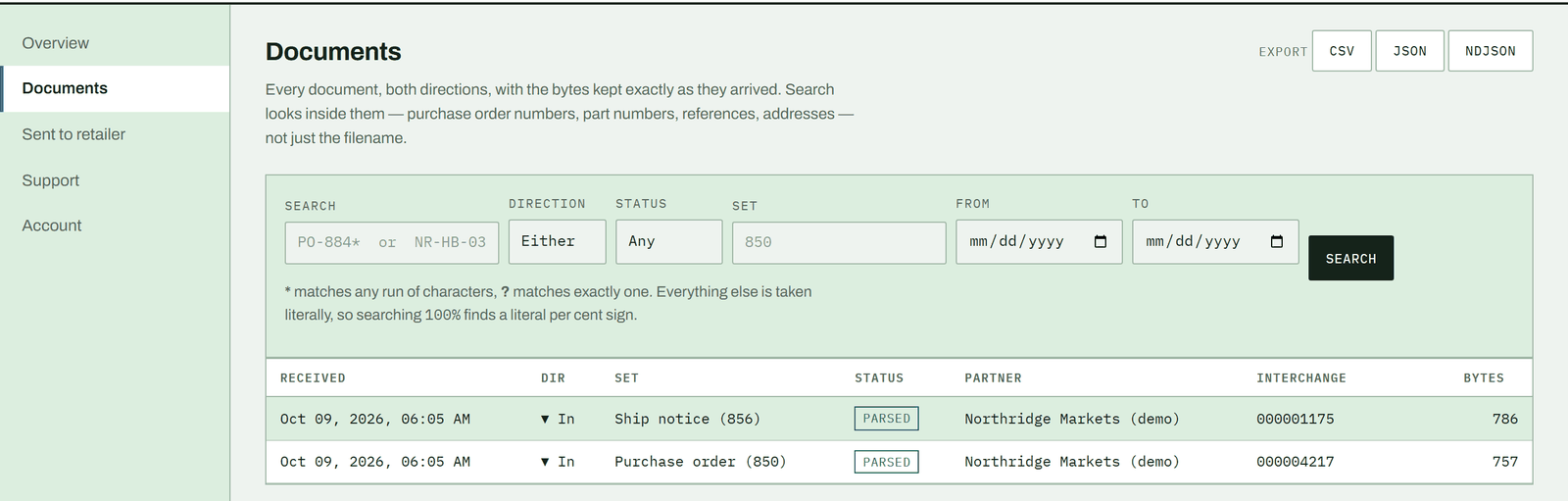
The bytes, kept exactly as they arrived
Every document is stored as sent, searchable by purchase order, part number or
address, and exportable whenever you want it. Six months later an argument about
what was ordered is settled by the file rather than by memory.
Partner quirks
Retailer templates
Required segments, qualifier overrides, date formats, packaging rules. Every
certified retailer becomes a template, so the second supplier onboards faster than
the first.
02
See the portal
One purchase order, from the file arriving to the invoice being checked against it.
Seven steps, about three minutes. Every document shown was produced by the software
itself: the printed order, the carton label barcode, the invoice warning.
Greenbargreenbar.palletlabs.orgWalkthrough · sample order
Every document, both directions, searchable inside the file.
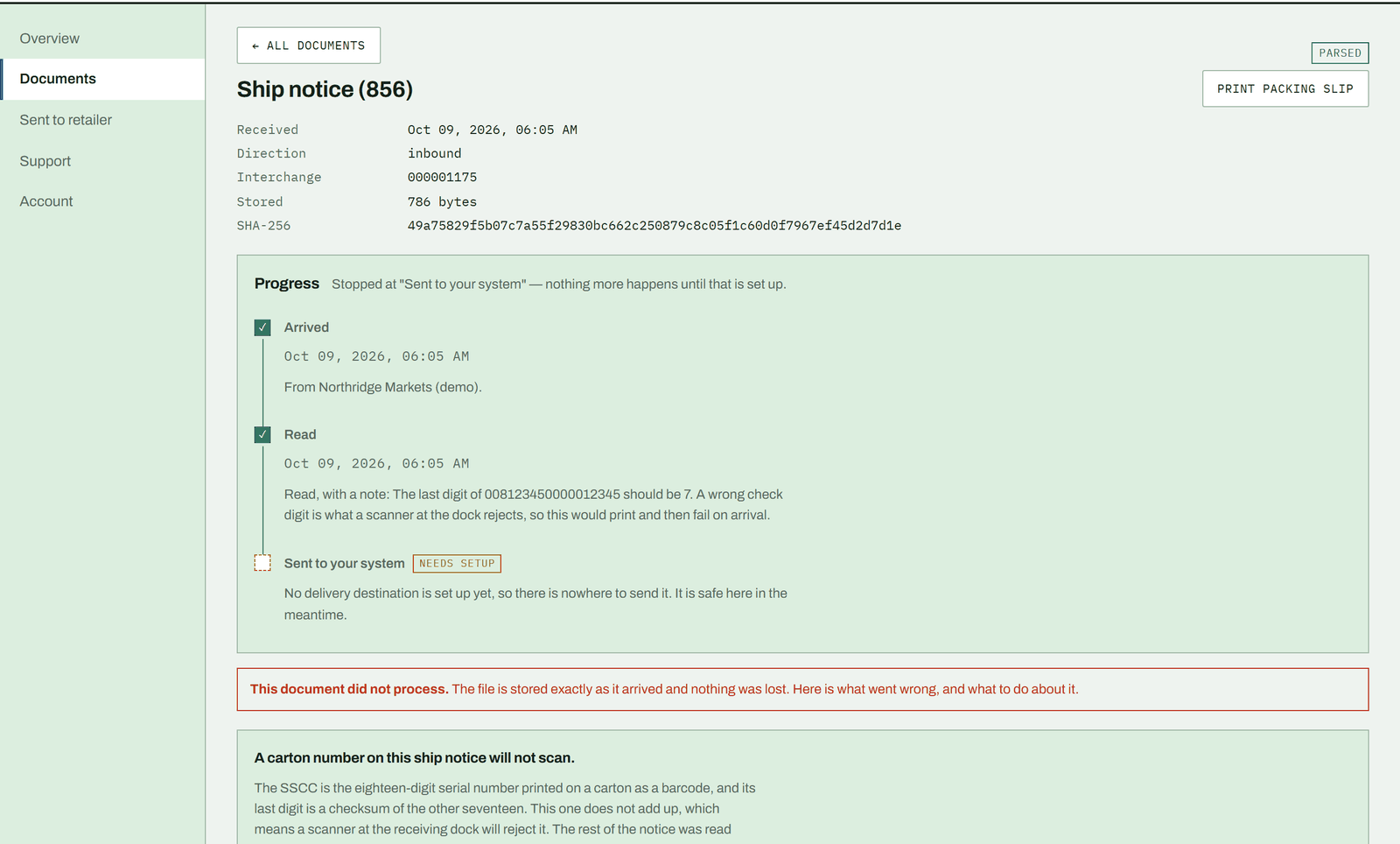
One document, with what happened to it and what is wrong in plain English
— this one caught a carton number that a scanner at the dock would
reject.
Purchase order, US Letter
Carton label, 4 × 6in thermal stock
Everything above came out of the software: two screens from the
portal, a real purchase order printed for the floor, and the GS1-128 carton
label that went with it. They are on this page as files, not as a script that
has to run.
Want one with your own retailer's files in it?
We will set up a practice account with a pretend retailer in it, and run your files
through it exactly as the real thing would. Everything in it is marked as a test, so
nothing can reach a retailer by accident. It is free, and setup is discounted while
the product is new.
03
What it costs
A flat monthly subscription, published here rather than quoted on a call. Nobody charges
you more for a good month: our fee does not move with your volume, and
it stops climbing however many retailers you add. Where a retailer forces us through a
network, that network's charge is variable and is billed on as a separate line —
it is the one part of your bill neither of us controls, and we would rather name it here
than have you find it later.
Compare the monthly figure if you like, but it is rarely where the money goes. Most EDI
is billed per thousand characters of the file, and a ship notice is a big file. That is
the number worth checking before you sign anything, including with us.
And when something does go wrong, the answer should not be a ticket number.
Every error we can produce is written out in plain English,
and the support address reaches a person.
All 10 founding places are open.The rate is locked for the life of the account.
Ten places, counted once. A founding customer who leaves does not free theirs.
Checked ; the
figure above updates live.
Founding — first ten customers
$69a month, documents not counted
The first ten accounts pay $69 for as
long as the account exists, and
documents are not metered at all —
ten a month or ten thousand, the bill is the same. We cannot raise it afterwards,
there is no onboarding fee, additional
retailers are $29 each, and you can
stop at any time without notice.
Standard
$79$199 to set up
One-off $199 covers the work of reading
your retailer’s implementation guide and building the mapping before anything
goes live. Additional retailers are
$39 each. Month to month, with no
annual commitment.
Documents
Not counted on the founding plan
Nothing we do costs us per document (reading one, mapping it, storing it, the
portal, SFTP, webhooks), so metering them would be a charge for nothing, in the
exact shape this page tells you to be wary of. On the standard plan one retailer and
500 documents a month are
included, and it is 6¢ a
document beyond that.
The ceiling
Subscription stops at $199
$149 on the founding plan. However many
retailers you add, the subscription stops climbing there. Usage sits on top of it,
because that part is a cost we actually pay and a cap over it would be a cap in name
only.
What a ship notice costs to send
6¢ here. Commonly 30¢ to $3 elsewhere.
Networks that bill by the kilocharacter charge somewhere between 3¢ and
30¢ for each thousand characters, depending on the network and your volume. A
grocery ship notice with its cartons and part numbers runs about ten of them. That
is per document, every document, and it is why the monthly price on a quote tells
you so little. On the founding plan we do not count documents at all.
Better still
A direct connection costs nothing per document
Plenty of retailers accept one without advertising it, and we always try for it
first. Where a retailer genuinely insists on a value-added network we pass that
network through at cost, with the figure shown before you commit. We do not mark it
up, because a margin on somebody else’s meter is a reason to stop looking for
the direct route. It is a variable line rather than a flat one: networks bill either
per thousand characters or a flat rate for each retailer you trade with, and on some
of them a supplier with three retailers pays more to the network than to us.
What we deliberately don't do. HIPAA healthcare claims (837, 835,
270/271, 834), pharmaceutical DSCSA and EPCIS, and freight (204, 214). Those are
different products with different compliance obligations, and we would rather say so
than take them on.
EDIFACT. The sets above are X12, used by North American retailers. We
also read UN/EDIFACT, for importers, exporters and 3PLs. An EDIFACT order arrives in the
same shape as an X12 one, so if you trade under both you work with one format rather
than two, and we send the CONTRL acknowledgement back automatically, the same way we
send a 997 to an X12 partner.
Formats and connections
The sets above are what your retailer sends. Below is how we fit around the systems you
already run: the files your software exports, the ways we connect, and what you get
back.
The standard
What your retailer sends
X12 — every set in the table above.
UCS — the grocery variant of X12.
EDIFACT — the international standard, for importers, exporters and
3PLs. Purchase orders today.
The file
What your system exports
CSV and other delimited text, including semicolon-separated.
XML — including SAP IDoc and Dynamics XMLport exports.
JSON.
Fixed-width — positional files from SAP, AS/400 and older ERPs,
including zero-padded numbers and trailing signs.
The connection
How it moves
SFTP — we host a mailbox for you, or deliver to theirs.
HTTPS API — post a document, get a reply.
Webhooks — signed and retried, with every attempt visible.
AS2 — we run our own AS2 server. Depending on the retailer we either
connect to them directly or route through a network, and the two differ in cost
and in how long they take to set up. Tell us who they are and we will tell you
which one applies.
The output
What you get back
JSON, CSV or XML, chosen per destination.
PDF packing slips and invoices, ready to print.
GS1-128 carton labels, to GS1 spec.
What we don’t support yet. We read XML; what we don’t read
is UBL, the particular XML invoice schema used for European e-invoicing.
XLSX is not an output option yet; spreadsheets come out as CSV. On EDIFACT we
read purchase orders and send back the acknowledgement, with other message types to
follow. Ship notices now carry lot numbers for the FDA food traceability rule
that applies from July 2028; expiry dates on a ship notice are not there yet. Ask
us if you need one of these and we’ll give you a date.
05
Grocery, properly
Grocery runs on its own transaction sets: a 875 instead of an 850, a 880 instead of an
810, and they are not simply renamed. Every one of these was built against the
retailer's own published implementation guide, not against the generic standard.
Retailers we have built against
Each of these publishes what they expect from a supplier, and we have read it and built
to it: the sets they require, their qualifiers, their date formats, their reasons for
rejecting a document. When you tell us who you sell to, that is already loaded.
SproutsPlain X12, and the remittance is required rather than optional.8 sets
AmazonPlain X12 over AS2, SFTP or a VAN. Vendor Central and Direct Fulfilment are two
different programmes, and the second needs an inventory feed.6 sets
The Home DepotFour sets direct; drop-ship adds the 855 and the 940/945 warehouse pair, and runs
through Rithum rather than directly.8 sets
Lowe’sShip notice within 24 hours of pickup, carton-level, with an SSCC-18 on every
carton. Roughly 60 days from approval to compliant.7 sets
Tractor SupplyThe ship notice has to beat the truck to the dock, and the PO number has to match
across all three documents.8 sets
Dollar GeneralEverything behind the DG Suppliers portal, and onboarding finishes before the first
order ships.4 sets
ChewyDropship: they sell first and order after, so the inventory advice is not optional
— it is what the listing is sold from.6 sets
WayfairDropship and CastleGate both, with one inventory feed spanning the two.6 sets
These are retailers, not our customers. We have no affiliation with any of them and none
of them endorse us. We have simply done the reading. If yours is not here, tell us and
it will be: their guide is usually public too.
This came out of a ship notice
A real label from our own renderer, on 4 × 6in thermal stock. The
SSCC on the barcode is the same number we put in the ship notice the retailer
receives, because both come from one allocation at the same moment, which is why the
dock scan and the notice cannot disagree.
GS1 state the bar heights and quiet zones in millimetres and a receiving scanner
rejects a symbol outside them, so none of it is ours to round.
Deductions
Why your payment was short
A remittance says money was held back. The credit memo that explains it says
why, against what, and for how many cases at what price. We read both and
put them together, so a deduction nobody explained becomes one you can dispute.
Rejections
“Invoice 30561: missing store number”
Retailers reject documents with a code and a segment position. We turn that into a
sentence naming the document, the problem and what to change.
Kroger
The ship notice rules, checked before you send
Kroger publishes the list of reasons they reject a ship notice: twenty-four of them,
each with a code. Several are impossible here by the way the thing is built: your
ship notice is you confirming an order we already hold, so it cannot quote a
purchase order they never sent, or a line that is not on it, or an item code they do
not recognise. Pallet serial numbers come out of a counter we keep and are never
issued twice, which is the duplicate-load rejection. Shipping nothing is refused
before it reaches them.
What we cannot check is anything that lives in their item file, such as cases per
layer, layers per pallet, how long a code date may run. Those we pass through as you
give them, and the 824 that comes back is turned into a sentence naming the item and
the problem.
Kroger
Pallet labels to their logistics spec
Four inches by six, GS1 SSCC-18, and the serial on the label is the serial in the
ship notice, so what the dock scans is what they were told to expect. The four
digits before the check digit are printed larger, which is in their requirements for
a plain reason: a driver has to tell one pallet from another across a dock, and
eighteen identical digits all look the same at four feet.
Kroger
Their numbers are already in
Setting up a retailer usually starts by copying four values out of a PDF, and
mistyping one means your files go out and land nowhere, which looks like a broken
connection and isn’t. For Kroger we already hold them: the qualifier, the
interchange ID, the group ID that is not the same as the interchange ID,
and the version they want. The setup screen shows the numbers instead of telling you
to go and find them. Ralphs, Fred Meyer, King Soopers and the other banners all
resolve to the same setup.
Order changes
“Line 2: cancelled — do not ship it”
Retailers change orders between sending them and the truck arriving, and the change
turns up as two-letter codes. We turn it into a list anyone can act on: which line,
what changed, and the new quantity. Not the quantity removed: that is the way this
document is most often read wrong, and it is the expensive way.
Routing
Who is collecting, and when
Some retailers want you to ask where to send a load before it moves. We send the
request with the carton count, weight and volume their routing desk needs to assign
a trailer, and read the answer back as a carrier and a collection date. The
different dates stay apart: “we collect Tuesday” and “do not ship
after Tuesday” are different instructions, and treating them as one loses you
days you were given.
Stock levels
What you can actually ship
Distributors ask for a stock file so they stop ordering what you haven’t got.
Every figure on it says which figure it is (available to sell, on hand, damaged),
because those are the same number and opposite news. We tell you by name what has
run out rather than leaving you to read a thousand rows.
Carton labels
GS1-128, from the ship notice
One printable label per carton, on 4 × 6 stock, carrying the same
SSCC we sent in your ship notice, so what the dock scans matches what they were told
to expect. We hold the serial number counter, so a number can never be reused.
Store data
What sold, what ran out
Daily product activity from the retailer's own stores, delivered as a spreadsheet
with one row per item and a column that says “out of stock”.
06
How it works
A retailer sent you an EDI deadline.
You forward it to us, we connect to them, and you read orders like email and confirm
what shipped.
That is the whole job. Everything below is for whoever checks the details.
What happens between agreeing a price and your first purchase order arriving. The work
is ours; the part you do is name your retailer and say what shipped.
We connect to your trading partner
Your retailer drops files on our SFTP, or we collect from theirs. You give them
one hostname and one IP address, and that's the last conversation about
connectivity. If they require AS2, tell us before you commit. We are building it
and we will tell you honestly where it has got to.
Their order arrives in a form you can read
In the portal, or sent wherever you want it: a spreadsheet by email, a file
dropped on your SFTP server, or JSON on a webhook if you have somebody to receive
it. Webhooks are signed with X-Greenbar-Signature and retried for 72
hours before being set aside, and never dropped. Dates are unambiguous, units are
explicit, and money is exact to the cent.
You answer it
Open the order in the portal, change the quantities that did not ship in full, say
how many cartons, and press send. Part numbers, prices and addresses come from the
retailer's own order, which removes the commonest cause of a chargeback: a ship
notice that disagrees with the purchase order. We generate the 855, 856, 810 or
880, allocate the control numbers, and build the structure the retailer's
receiving system expects. If you would rather do it from code:
POST /v1/acknowledgments, /v1/shipments,
/v1/invoices.
Everything is kept, and everything is replayable
The retailer's file is saved exactly as it arrived, before anything tries to
read it. If we cannot make sense of one, the document is flagged and the file is
kept, never thrown away. Any document can be read again and resent from the
portal.
07
Security
Your purchase orders, your prices and your trading relationships end up in one place.
That is the point of the product and it is also the risk, so these are built in.
Access
Keys that can only do one thing
An API key carries a list of what it may do, and can mint another key with less
access and never more. Hand a reporting tool or an agent a credential that can read
orders and nothing else, without going through us.
Sign-in
Two steps, account-wide
Anybody can turn on two-step sign-in for themselves; an account can require it of
everybody on it, including the people who have not got round to it. Our own staff
carry one always, because one staff password would otherwise be every customer's
documents.
Audit
Evidence you can check yourself
Every document read, and every read we refused, goes to a log that nobody can edit
or delete, and that is built so any change would show. One check tells you whether
it has been altered, which is what an auditor asks for.
Your files
Kept exactly as they arrived
The original bytes are stored before anything is parsed, and encrypted backups run
every day with the restore procedure written down and scripted. Documents are yours
to export in full, at any time, without asking.
08
Engineering commitments
Rules the code is held to rather than intentions. Each one has a test behind it, and
each is written so you can tell when we have broken it.
✓Never lose a documentRaw bytes and a database row exist before parsing begins. Failures are recorded
against the stored file, not swallowed.
✓Everything replayableAny document can be re-parsed and re-delivered from the original bytes.
✓Duplicates flagged, not processed twiceInbound documents are keyed by interchange, group and transaction control number. A
resend is recorded and marked, never double-handled.
✓Outbound X12 round-trips before it's sentSerialized, re-parsed with our own parser, validated. If it wouldn't survive our
validator it doesn't reach your retailer.
✓Money is never a floating-point numberAmounts are exact integers carrying their own scale. A four-decimal grocery cost
survives intact, and no total is ever a rounding of a rounding.
✓Every error says what to do about it161 of them on the public page, each written out in full: what it means, what
caused it, and the next step. Generated from the code, so the list cannot drift from
what the software actually reports.
` would end the outer one and spill half a
founder card onto the page. Taking it down costs the audit's founder-led-trust score, which
was 2/6 precisely because no person was visible anywhere on the site. If it stays parked,
that finding stays failing. -->
Onboarding the first suppliers now
If a retailer has sent you an EDI implementation guide and you'd rather not read it,
that's exactly the problem we're built for. Tell us who your trading partner is and
which documents they want.

 Open the portal